Spain World Cup qualifiers 2025 and the unbeaten run built on grit and heart
Spain World Cup qualifiers 2025 has become a shorthand for something bigger than a results column. It is a story of a team that keeps refusing to lose, of a goalkeeper who turns chaos into calm, and of a dressing room forced to confront the cruel timing of injury just as the stakes reach their highest point.
Across the latest window of elite competition, Spain have again looked like a side built for the long haul. They have matched a towering landmark, equalling a 31-game unbeaten record, and they have put themselves in position to collect more silverware, entering the second leg of the Uefa Women’s Nations League final against Germany after a hard-earned goalless draw in Kaiserslautern.
And then, just when rhythm felt settled, came the gut punch. Midfielder Aitana Bonmati fractured her left fibula after falling awkwardly in training at Spain’s base in Madrid on Sunday, an injury confirmed by tests carried out by the Royal Spanish Football Federation medical services. Barcelona said they were waiting for her return to the club to decide on treatment.
A goalless first leg that was anything but quiet
If you only scan the scoreline from Fritz-Walter-Stadion, the opening leg reads like a stalemate. Watch the pattern of chances and you see something else. Spain, the World Cup holders, were pulled into a night where survival required precision, patience, and a goalkeeper willing to do the loud work of keeping a final alive.
Germany started with early intent, Nicole Anyomi firing just past the post, and the pressure kept coming in waves. Cata Coll was the busier goalkeeper throughout, producing a string of saves that gave Spain a foothold in a match that repeatedly threatened to tilt away from them.
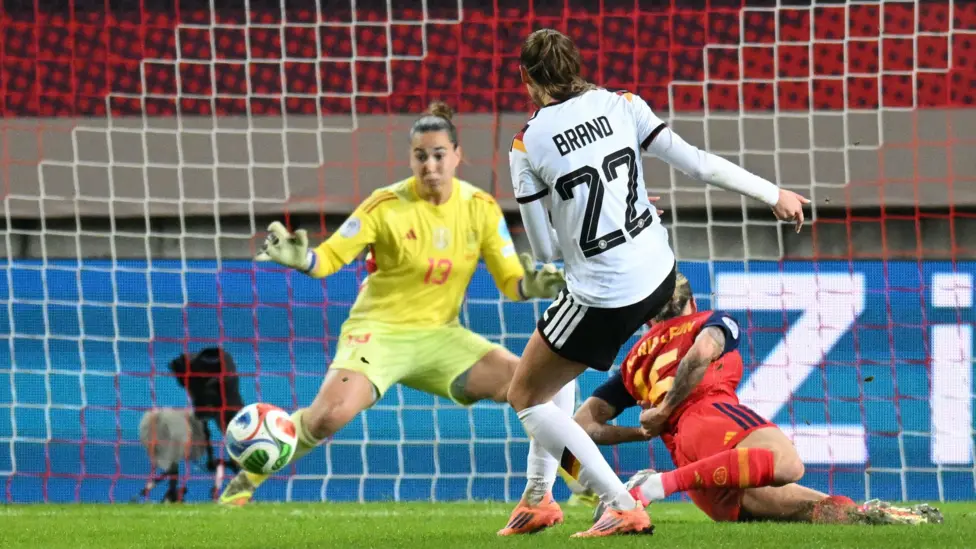
Coll’s interventions were not the kind that make for easy highlights only. They were the kind that change a team’s breathing. Klara Buhl’s close-range effort from a tight angle was turned away. Franziska Kett was denied with Coll’s legs. And when Jule Brand looked set to break through, Spain captain Irene Paredes cleared a shot off the line, a moment of leadership that felt as decisive as a goal.
Spain did not spend the entire night hanging on. After the interval they showed more bite, and Esther Gonzalez struck the post eight minutes into the second half after getting on the end of Mariona Caldentey’s cross. Yet Germany carried their own menace, with Buhl striking the woodwork herself from the edge of the box midway through the second half.
Even in stoppage time there was no guarantee the tie would remain balanced. Coll blocked an effort from Sjoeke Nusken and the rebound fell to Shekiera Martinez, but Martinez fired wide. When the final whistle arrived, the 0-0 felt less like a pause and more like a promise that the return leg in Madrid would demand everything.
Cata Coll and the anatomy of a final
Finals often turn into tests of nerve, and Spain’s first-leg story begins and ends with their goalkeeper. Coll did not just make saves, she shaped the match’s emotional temperature. Every time Germany found a seam, she closed it quickly enough to stop panic spreading through the back line.
In a sport where confidence can be as contagious as doubt, Cata Coll delivered the kind of performance that makes a team believe it can win even on a night it is not dictating the terms. Spain will look at the second leg knowing they were outshot in moments, outstretched in others, and still came away with the one result that keeps the trophy within reach.
Aitana Bonmati injury changes the mood around Spain
The football calendar rarely offers kindness, and Spain learned that again in the most personal way. Bonmati, 27, fell awkwardly during a practice session in Madrid on Sunday while Spain were preparing for the second leg of the Nations League final against Germany at the Estadio Metropolitano.
The timeline makes the blow sting more. Bonmati played 77 minutes in the first leg in Kaiserslautern, a match that demanded midfield control under pressure. Then, days later, she is suddenly forced out not by an opponent’s tackle but by a training ground moment no one can script around.
Spain manager Sonia Bermudez captured the tension between ambition and duty. Bonmati wanted to stay with the group for the final, but the decision was made for her to return to Barcelona to begin recovery because, as Bermudez said, the health of the players comes first. Spain also made their intention emotional as well as competitive, with Bermudez adding that the team want to dedicate tomorrow’s victory to her.
There is no way to dress that up. Aitana Bonmati is not only a tactical piece. She is a teammate, a standard-setter, and someone whose presence can lift a room before the ball is even kicked.
Irene Paredes gives voice to what teams feel but rarely say
When a player goes down in training, the group absorbs it differently than an injury picked up during a match. It hits the routine. It interrupts the rhythm of preparation. It forces everyone to picture the moment in their mind even if they did not witness it.
Paredes, who plays alongside Bonmati at Barcelona, gave an unusually human snapshot of that shock. She said absences like Bonmati’s can unsettle you, because no one likes seeing a teammate hurt or injured. She called it a significant loss for both the national team and Barcelona.
Her description landed because it was simple. She did not pretend it was fine. She said she did not see what happened, but Bonmati told her about it, and you could see the pain in her eyes and it was clear something serious had occurred. Paredes sent encouragement, wished her a full recovery, and promised the team will keep pushing.
That is what elite sport asks for when it takes something away. Resilience does not mean you feel nothing. It means you carry the feeling and still do the job.
Why Spain’s unbeaten run matters beyond the number
Records can be sterile when they are separated from context. Spain equalling a 31-game unbeaten record is impressive on its own, but the way they protect that run is what reveals their maturity. In Kaiserslautern, it was not a showcase of unbroken dominance. It was a case study in enduring discomfort.
That is the mark of a side ready for tournament pressure, whether in a World Cup qualifying campaign or a two-legged final. You do not always get to play on your terms. Sometimes you need a captain on the goal line. Sometimes you need the goalkeeper to win duels that feel like they last the entire match.
Spain’s identity in this period has also been shaped by the personalities inside it, not just the patterns on a tactics board. Bonmati’s injury lands so heavily precisely because her year had been so luminous, and because her story and Spain’s story have been intertwined in success.
Bonmati’s stellar year and the cruel timing of setbacks
The injury is a disappointing end to what has otherwise been a stellar year for Bonmati. She became the first player to win the women’s Ballon d’Or three times, achieved a domestic treble with Barcelona, and reached the Euro 2025 final with Spain. Uefa also named her the Champions League player of the season.
That list reads like a career, not a year. And that is why this moment cuts through. It reminds you that the sport can elevate a player to historic heights and then, in a single awkward fall, demand patience and pain tolerance in return.
Barcelona will determine the treatment plan once she returns, but for Spain the immediate reality is clear. The second leg arrives without one of the game’s defining midfielders, and the emotional responsibility of responding to that absence will sit alongside the tactical challenge of beating Germany.
What the second leg demands from Spain
The teams meet again on Tuesday, 2 December at Estadio Metropolitano in Madrid, with the tie level after the scoreless first leg. The stage is built for big moments, but big moments are not always created by star turns. Sometimes they are created by shared sacrifice.
Spain’s blueprint from the first leg suggests three themes that will likely decide the return match
- goalkeeping that holds the line when Germany find space,
- leadership that stays sharp in the penalty area,
- attacking efficiency when chances finally arrive.
On the night in Kaiserslautern, Spain showed they can survive Germany’s best spells and still land their own punches, with Gonzalez striking the post and Caldentey supplying the kind of delivery that can flip a final in a single action.
Now the question is whether Spain can turn that resistance into celebration, and whether they can do it with Bonmati watching from the outside. If they manage it, it will not simply be another notch in an unbeaten run. It will be a reminder that trophies are often won in the moments when a team has to become more than the sum of its available players.
We want to dedicate tomorrow’s victory to her.
Sonia Bermudez on Aitana Bonmati
In that single sentence is the heart of why the current Spain story resonates. It is not just about records or status as World Cup holders. It is about carrying someone with you, even when she cannot take the field.