
Real Madrid vs Manchester City Champions League defeat and Rodrygo revival
On another tense European night at the Bernabeu, Real Madrid vs Manchester City delivered not only a 2-1 comeback win for the Premier League champions, but also a mirror held up to a club in the middle of an identity crisis. The scoreline will live in the record books, yet the real story is written in the faces that left the stadium under a chorus of whistles and the fragile hope carried by one Brazilian forward rediscovering himself.
How Manchester City turned the Bernabeu into their stage
The script initially looked perfect for Real Madrid. Still smarting from a weekend defeat to Celta Vigo and with pressure growing on Xabi Alonso, the Bernabeu crackled with that familiar anticipation reserved for big European nights. Manchester City, coached by Pep Guardiola and brimming with experience, arrived as a measuring stick for where this evolving Madrid side truly stands.
Madrid thought they had their dream start. Vinicius Junior went down under a challenge from Matheus Nunes inside the opening minutes and Clement Turpin pointed to the spot, only for VAR to intervene and reveal the contact happened outside the box. The decision deflated the early roar, but it did not change the tone of an aggressive, front-foot Real Madrid.
Despite Kylian Mbappe being kept on the bench due to knee discomfort, Alonso’s team imposed themselves for long stretches of the first half. Manchester City, by Guardiola’s own admission, “weren’t controlling the game” and “weren’t being aggressive” until the tide shifted. Madrid’s intensity, the pressing, the waves of attacks down the flanks – all of it suggested a side refusing to bow to the narrative of crisis.
Rodrygo writes his own redemption chapter
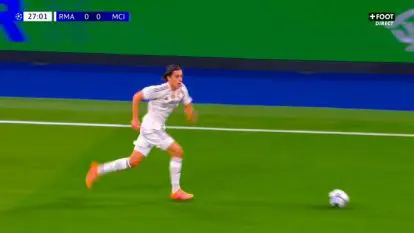
The moment that truly ignited the Bernabeu came just before the hour mark, and it belonged to Rodrygo Goes. Slipped through by Jude Bellingham, Rodrygo took a sharp touch and fired low across Gianluigi Donnarumma into the far corner, a finish that stitched together elegance and release. It was his fifth goal against Manchester City and, perhaps more significantly, his first at club level in 33 matches.
For a forward who has lived through weeks of doubt and reduced minutes, the goal felt like more than a statistic. It was relief made visible, a reminder of why Guardiola would later call him “a player of another level”. The City manager sought him out after the final whistle to tell him just how good he is, admitting he was “very, very good” and expressing happiness that Rodrygo had returned from injury to this level.
Xabi Alonso echoed that sentiment, describing him as a “great Rodrygo” and stressing how important it was to see him unbalancing defences again. In a night that ultimately ended in defeat, this was one of the few strands of optimism the club could cling to, a sign that one of their most decisive European performers is resurfacing at a crucial time.
The ten-minute collapse that changed everything
Madrid’s lead, however, existed only in the thin space between hope and reality. Within 10 brutal minutes, Manchester City not only equalised but twisted the knife with a clinical demonstration of what separates a side in control of its destiny from one wrestling with its own doubts.
The first blow came from a corner. A delivery from the right was headed goalwards, and Thibaut Courtois – usually the picture of security – failed to hold onto the ball. Nico O’Reilly, alert and ruthless, pounced inside the six-yard box to tap in his first ever Champions League goal. For a player who has been at City since the age of eight, it was a moment of pure childhood dream colliding with elite reality.
Less than 10 minutes later, another familiar European image unfolded. Antonio Rudiger tangled with Erling Haaland inside the penalty area, and after a VAR check, Turpin pointed to the spot. Haaland, described in coverage as the “coolest man in the Bernabeu”, rolled in his 55th Champions League goal with an inevitability that must haunt opposing defenders.
In that brief span – a corner, a goalkeeper error, a penalty, a world-class striker doing what he does – Madrid’s control melted away. Alonso would later admit that “in 10 minutes, with a corner and a penalty, they take the lead, when the game was serious, competitive”. It is in those flickering windows, when the game tilts, that elite sides reveal who they truly are.
Guardiola’s verdict on Madrid and the refereeing storm
From the Manchester City perspective, this was not the polished, possession-perfect machine that has so often dominated Europe. Guardiola was candid in his assessment, conceding that until Rodrygo’s opening goal, his team “weren’t controlling the game” and that Madrid “hurt us a lot in attack”. Only after finding the equaliser did City “find the way” they needed to play.
He also highlighted Madrid’s physical and tactical edge in the first half, pointing to their injury problems yet acknowledging how dangerous they remained. With Vinicius open, Endrick introduced, and several bodies flooding the box, Guardiola reduced City’s task in simple terms – “the question is to survive”. Coming from a coach synonymous with control and dominance, that is as high a compliment as any.
Yet Guardiola did not leave the Bernabeu without controversy. On the refereeing front, he insisted that the penalty awarded to Haaland was “very clear”, while arguing that Antonio Rudiger should have seen a second yellow card for a late challenge on Savinho. That decision – or non-decision – added another layer of tension to an already febrile atmosphere, and underlined how fine the margins were in a contest Madrid ultimately lost but never truly surrendered.
Xabi Alonso’s stance under growing pressure
In many ways, Xabi Alonso’s post-match words were as revealing as the ninety minutes themselves. “We have nothing to reproach ourselves for,” he said, stressing that his players “tried until the end” and that the game had been “serious, competitive” until those fateful ten minutes. It was not the language of a coach ready to capitulate to narrative; it was the voice of a man convinced his ideas are close to bearing fruit.
He praised the attitude and the effort, lamented the lack of “finesse” in front of goal, and invoked the unity between the squad and fans as the path forward. The connection with the supporters, he said, is how “we can turn it around”. It is telling that in a stadium that ended the night with loud whistles, Alonso still chose to see – and highlight – the bond rather than the fracture.
Asked about his own future, Alonso was pointedly brief. He admitted only to being “worried about the next game”, insisting that “the important thing is Real Madrid” and not himself. In a club where the manager’s seat has always been hot, it was both a deflection and a reminder of the institution’s hierarchy of priorities.
Inside the dressing room performance Real Madrid player ratings
The numbers and assessments from the night draw a clear picture of a team with individual bright spots, but also glaring issues. Thibaut Courtois, given a 6.5, epitomised that contradiction – responsible for the mistake that led to Nico O’Reilly’s equaliser, yet also producing several big saves to keep Real Madrid in contention.
In defence, Fede Valverde’s 6 at right-back reflected a night where his usual midfield dynamism did not translate into decisive influence from deeper wide areas. Raul Asencio, thrown into the starting XI due to injuries to Eder Militao and Dean Huijsen, struggled against Haaland and was eventually sacrificed for extra attacking firepower, finishing with a 5.5.
Antonio Rudiger also received 5.5, his evening defined by the penalty he conceded and the reprieve from a second yellow card that Guardiola felt he did not deserve. The one standout at the back was Alvaro Carreras, rated 7, who not only defended better than any of his colleagues but also helped win the ball back in the sequence that led to Rodrygo’s goal.
In midfield, Aurelien Tchouameni’s 6 reflected a relatively quiet outing in a contest where City preferred to attack down the flanks rather than through the middle. Dani Ceballos, handed a rare start, could not seize his chance, his 5.5 underlining a performance where he was “barely noticeable” before being withdrawn after 66 minutes.
Jude Bellingham, so often the heartbeat and headline-maker, had a rare off night in front of goal despite contributing the assist for Rodrygo’s opener. Rated 6, he worked hard but lacked the usual crispness, highlighted by a huge missed chance in the second half when he miscued a chipped effort to level the game.
In attack, Rodrygo’s 8.5 made him the undisputed star for Madrid. A one-man show, constantly threatening and finally rewarded with a goal that snapped his drought, he once again showed why he “loves playing against Man City”. Vinicius Junior opened brightly, almost winning that early penalty and constantly probing, but drifted and later missed key chances, ending with a 6.5.
Gonzalo Garcia, preferred to Mbappe from the start due to the Frenchman’s fitness issue, could not impose himself and was inevitably the first player substituted, earning a 6. From the bench, Arda Guler and Brahim Diaz both received 6, offering brief threats without game-changing impact, while Endrick, also rated 6, came closest of the substitutes with a late effort that almost delivered an equaliser.
The Bernabeu verdict whistles, anxiety and a coach on the edge
The most chilling sound in football is not always the roar of a rival’s fans, but the whistles of your own. At full time, with Real Madrid consigned to a second home defeat in four days and their second loss of this Champions League campaign, the Bernabeu spoke loudly.
The whistles were not just about one match. They were about a run that now reads two wins from eight games in all competitions, with three draws and three defeats. They were about a La Liga lead evaporated, replaced by a four-point deficit to Barcelona. They were about a Champions League league phase campaign that has suddenly become more complicated, with a top-eight spot now genuinely in doubt.
For a club that measures itself against perfection, those numbers are intolerable. Yet inside the boardroom, the tone – for now – is less explosive. Reporting from Spain suggests that senior Real Madrid officials are not currently “expressing concern” about Alonso, despite the Manchester City defeat and the broader slump.
Crucially, Alonso will be on the bench for Sunday’s trip to Alaves, a match now loaded with significance beyond three points. After that come fixtures against CF Talavera de la Reina in the Copa del Rey and Sevilla in La Liga, rounding out the calendar year and offering either a springboard or a trapdoor.
Why the next three games could define Xabi Alonso’s Real Madrid project
The context around this Manchester City defeat makes it more than just a bump in the Champions League road. Real Madrid have already lost top spot domestically, and their margin for error before the winter break is shrinking quickly.
The club’s hierarchy may not be contemplating a change of manager “currently”, but that stance is conditional. If Madrid lose further ground to Barcelona in the La Liga title race in the coming weeks, the extended winter pause would provide the ideal window to source and install a replacement. The winter break, always a moment for reflection, threatens to become a referendum on Alonso.
That is why Alaves away, Talavera in the cup and Sevilla at home carry such weight. They are not just tests of tactics or squad depth, but of Alonso’s ability to steady a shaken dressing room and reconnect a restless fanbase to his project. A convincing run could transform the atmosphere, just as another stumble could turn that cautious boardroom patience into decisive action.
What this defeat really tells us about Real Madrid vs Manchester City
Strip away the emotion and the noise, and this 2-1 loss to Manchester City offers a brutally clear snapshot of where Madrid stand. They remain capable of dominating stretches of play against Europe’s best, of unsettling Guardiola’s structure, of unleashing talents like Rodrygo and Vinicius who can change a match in a heartbeat.
But they are also fragile in key moments, too dependent on individual inspiration, and short of the ruthless efficiency that defines recent Manchester City vintages. Courtois’s error, Rudiger’s penalty concession, the squandered chances from Bellingham and Vinicius – these are the details that separate a brave performance from a winning one.
For City, the evening confirmed their maturity. Even far from their best, they found a way. O’Reilly’s poacher’s finish, Haaland’s ice-cold penalty, Guardiola’s pragmatic survival mindset – it all spoke of a club that understands the grind of elite competition, and knows that style points are optional when results are compulsory.
An emotional night and the thin line between crisis and comeback
The Bernabeu has seen European catastrophes and miracles, collapses and remontadas. This night against Manchester City does not fit neatly into either category. It was neither humiliation nor triumph, but something in between – a painful lesson wrapped around a performance that contained real substance.
For Xabi Alonso, the task now is to turn that substance into results. To harness the version of Rodrygo that dazzled here, to coax sharper finishing from Bellingham and Vinicius, to restore defensive serenity and emotional calm. His insistence that “we have nothing to reproach ourselves for” speaks to a belief that the foundations are sound, even if the façade is cracking.
For the fans, this was a reminder that the Real Madrid badge does not grant immunity from suffering. The whistles, the anxiety, the tension in every misplaced pass – these are also part of the club’s identity, the demanding edge that has fuelled so many glorious nights.
And so the story moves to Alaves, to Talavera, to Sevilla. The Manchester City defeat will linger as a warning, but also as a pivot. It showed a team still capable of standing toe to toe with the European champions, yet also one that can be undone by a handful of moments. Between those two truths lies the fate of Xabi Alonso’s project – and the next chapter in this turbulent winter at the Bernabeu.