
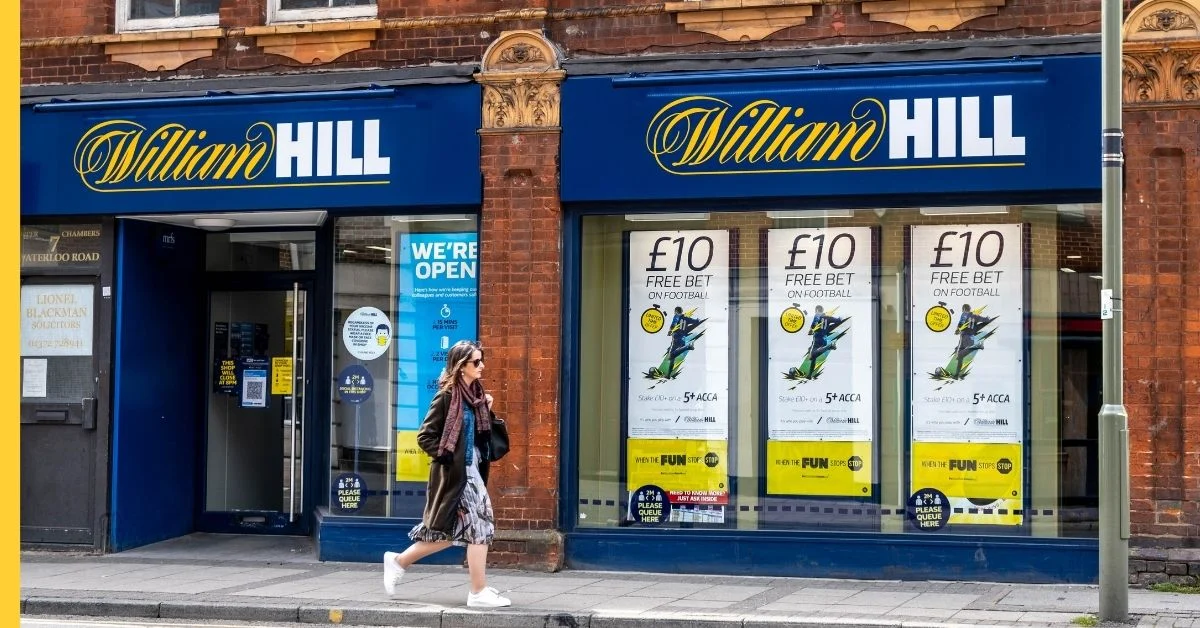
Betfred and Bally’s weigh William Hill retail assets
Betfred and Bally’s consideration of William Hill assets has surfaced at a moment when the UK betting market is being squeezed from multiple angles, higher taxation, structural debt, and a growing investor push for break-ups that unlock near-term value. According to multiple sources cited by NEXT.io, Betfred is weighing a possible purchase of evoke’s William Hill retail estate, with talks described as exploratory and with no final decision made.
If this story progresses, it will not just be another M&A headline. It will be a stress test for how much strategic value remains in betting shops in 2026, and whether scale, cost control, and location coverage can still justify paying up for bricks-and-mortar assets.
What is actually on the table
NEXT.io reports that any potential deal would likely be limited to the retail portfolio, rather than William Hill’s online business. That distinction matters, because it cuts across the omni-channel narrative evoke has sold to investors, the idea that online and retail together create a stronger, more defensible operation.
The context is stark. Evoke is fighting for survival amid a reported £2bn debt pile largely tied to its acquisition of William Hill’s non-US assets from Caesars Entertainment in 2022. The UK Government’s decision to dramatically hike gambling taxes in the Budget has, per the report, further put the company’s future in doubt.
Against that backdrop, evoke launched a strategic review in December that is expected to result in some form of break-up. In its market statement, evoke said the review would consider options to maximise shareholder value, including a potential sale of the group, or some assets and or business units.
Why Betfred is the natural retail buyer on paper
One source told NEXT.io that evoke assets are being shopped around, and argued that Betfred is the only UK operator that makes sense on paper as a buyer of William Hill’s vast retail estate. The reasoning is classic retail logic, economies of scale still matter when you run a large shop estate, and the operator with the tightest operational discipline often extracts the most value.
William Hill’s retail footprint was framed as a key driver, and it also speaks to a long-standing geographic narrative in UK betting. The report notes that Betfred’s representation in London and the South-East has historically been considered a weakness for the Warrington-based bookmaker, making William Hill’s strong and diverse estate strategically attractive if the locations complement Betfred’s current coverage.
A source quoted in the article suggests Betfred could identify significant cost savings, putting an estimated £20m to £30m of costs on the table through more aggressive operational management. Whether or not that number ultimately holds, it captures the core Betfred thesis, run the shops harder, simplify overhead, and let scale do the rest.
The problem that keeps coming back is price
Synergy stories are easy to tell, but they often fall apart when valuation meets reality. The same NEXT.io report flags that Fred Done’s no-nonsense approach could be a sticking point, because he would be unlikely to pay a premium for the portfolio.
That becomes especially important given evoke’s leverage. The report states evoke’s debt is currently standing at 5.0x EBITDA, which means any deal must involve a premium for retail, well beyond historical transactions described in the piece as old money deals like Entain’s purchase of Ladbrokes-Coral.
One industry source in the report warns that any multiple paid above 3 to 4.0x EBITDA would effectively front-load the value of a turnaround, because cost savings and operational improvements would be captured by the seller through the purchase price. In other words, the buyer would do the work, but pay for the results upfront, undermining the logic of the deal.
This is where the story becomes less about whether Betfred could run William Hill shops well, and more about whether the parties can agree a structure that satisfies debt-driven seller needs without destroying buyer economics.
Why splitting retail from online is strategically messy
A retail-only sale would, as NEXT.io notes, kill evoke’s overarching omni-channel story, potentially devaluing the online business at the worst possible time. For operators and investors, the omni-channel pitch is not just a brand line, it is a framework for cross-selling, loyalty, and retention across touchpoints.
Remove the shops, and you risk reframing the online business as a standalone asset competing in an intensely competitive market, while also stripping away a physical footprint that can anchor brand visibility in key regions. For evoke, that could mean that a retail sale solves one problem while creating another, which is why the article hints that a simultaneous sale of the online business could be a potential solution.
Where Bally’s enters the picture
The Bally’s angle adds an international dimension and suggests that this is not only a Betfred story. NEXT.io cites a report in the Greek press stating that Bally’s Intralot was plotting market share gains via M&A in the UK, and that it was engaged in discussions with an historic betting brand on the island looking to reduce high debt.
That language maps closely onto the evoke situation described in the article, although the NEXT.io piece stops short of confirming a direct one-to-one link. Still, the strategic logic is clear, if tax headwinds are rising, some operators may see acquisition as a way to buy scale, distribution, or a legacy brand position rather than relying purely on organic growth.
Debt, cash generation, and the retail paradox
One of the most revealing lines in the report is the reminder that retail is actually quite cash generative. That is the paradox for evoke. Selling a cash-generating estate can deliver proceeds, but it can also remove a steady stream of cash that helps service debt.
Another source quoted by NEXT.io argues that unless evoke achieves a very premium multiple, selling retail on its own may not materially improve its ability to service its debt. This puts pressure on the seller to push for a higher valuation, while simultaneously making the deal less attractive to a disciplined buyer that believes value comes from operational improvement.
Local competition could become the hidden deal killer
Even if price and structure align, shop estates come with a practical problem that digital-first analysts sometimes overlook, proximity. NEXT.io notes that the physical location of betting shops relative to one another, and local competition, could complicate any transaction.
A sub-deal with another mid-sized operator, or shop closures, were mentioned as potential solutions, but both add complexity and cost. In retail betting, an acquisition is not only a transfer of leases and staff, it is also a map-based optimisation project that can trigger regulatory scrutiny, local saturation issues, and hard decisions about which sites to keep.
How markets are reacting and what it signals
Evoke’s share price has climbed significantly in recent days, rising close to 20% from 12 January and up 33% through the month, according to NEXT.io. One anonymous analyst told the outlet that the spike reflects rumours among investors over possible M&A, while cautioning that the improvement came from a very low base.
That is a familiar pattern in stressed situations. Strategic review language often becomes a catalyst for speculation, because investors try to price in potential break-up value, even when the path to a clean transaction is uncertain.
What this could mean for the UK betting landscape
The deeper narrative behind Betfred and Bally’s consideration of William Hill assets is about what the UK market rewards in 2026. Regulation and tax changes are putting pressure on margins, and balance sheets with heavy leverage have less room for error. In that environment, the industry tends to split into two camps, operators that can use scale and efficiency to defend profitability, and operators that become forced sellers of assets that are valuable but difficult to optimise quickly.
If Betfred proceeds, it would be a signal that UK betting retail is still seen as strategically relevant when combined with operational discipline and the right geographic fit. If Bally’s becomes involved on the online side, it would suggest that international groups still view the UK as worth buying into, even under heavier tax headwinds, provided the entry point comes through distressed or restructuring-driven opportunities.
Key strategic forces shaping the outcome
- valuation pressure driven by evoke’s leverage and need for premium proceeds,
- deal structure risk because separating retail from online undermines the omni-channel investment narrative,
- execution complexity linked to overlapping shop locations and the practical cost of rationalising an estate.
What to watch next
NEXT.io describes the discussions as exploratory and notes that both Betfred and Bally’s declined to comment further. That leaves the industry watching for signals rather than confirmations, movement in evoke’s strategic review process, firmer reporting on which assets are being actively marketed, and whether a two-part process emerges that places retail with a UK operator and online with a different buyer.
For now, the most grounded takeaway is that the William Hill retail estate remains an asset that can attract credible interest, but only if the numbers work in a world where debt costs and gambling tax headwinds are reshaping what good value looks like.